| Facilitate the continuous improvement of enrollment processes, including those related to selective admission and Early College programs. |
|
| 1: Student Success
5: Structure and Processes
|
3-Teaching & Learning: Quality Resources & Support
5-Resources Planning & Institutional Effectiveness
|
1. Support Deans and other key stakeholders in meetings with Program Coordinators to better understand and align the resource needs and admission process within their areas.
2. Expand footprint for dual credit and Early College opportunities across the BR service area.
|
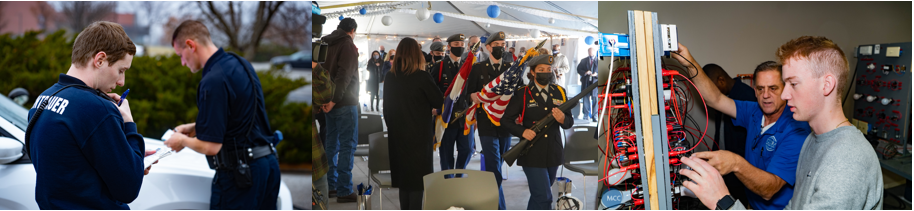
1. Coordinate efforts to draft appropriately consistent process models for admission to Fire, Police, and Lineman programs.
2. Enhance communication with partner school districts to understand dual credit/Early College needs and plan accordingly.
|
1. Operationalize recommended processes for selective admission programs effective Summer 2022.
2. Meet with leaders and key stakeholders from all 5 service area school districts to de-brief on recent and current dual credit experiences and develop plans for future semesters.
|
1. A workgroup was convened in Fall 2021 to review and propose adjustments to current recruitment and enrollment processes within selective admissions programs at MCC-Blue River. From there, three subgroups were established to focus specifically on each selective admissions program: Line Worker, Police, and Fire. These subgroups met throughout the fall and spring semesters, reporting back to the larger team to share out status reports and allow broader coordination of efforts. Updates have been made to student on-boarding processes for all three programs, to be operationalized with recruiting and enrolling of students into the various programs' next available cohort.
2. Meetings and communication occurred with representatives of all 5 service area school districts during 2021-22 (Blue Springs, Fort Osage, Grain Valley, and Independence) to manage current partnerships and work toward future opportunities. Ideas that were generated from these conversations included a 1/2 day Early College program with Oak Grove and Grain Valley and the Police Academy's gap year program with Independence and Fort Osage. Structurally, these programs are designed and ready for student enrollment, in the hope of starting with an initial group of participants in 2022-23.
|
1. As the work of streamlining our processes should be an ongoing effort, key stakeholders within the Line, Police, and Fire programs, as well as enrollment staff and department leaders, will re-group in the coming year to assess the impact of changes made and identify additional ways to improve efficiency.
2. During the 2022-23 academic year, it will be important to follow up on the structural work that has occurred and ensure full alignment between high school offerings and the college credits available through these programs, complementing rather than competing with existing dual credit opportunities for students whenever possible. Incorporating articulated or dual credit coursework into the gap year concept would also allow full buy-in from the high school partners.
|
Completed
|
No
|
|
| | Oversee implementation of strategic scheduling processes at MCC-Blue River, ensuring that all relevant campus stakeholders are involved in developing semester schedules. |
|
| 1: Student Success
5: Structure and Processes
|
3-Teaching & Learning: Quality Resources & Support
4-Teaching & Learning: Evaluation & Improvement
|
.1. Ensure that the schedule-building process at the BR campus includes cross-collaboration between Division Chairs, Coordinators, and Enrollment/Advising staff.
2. Introduce and implement block scheduling strategies as best practices for schedule development.
|
1. Utilize block scheduling models to ensure that students can complete full-time programs of study at the BR campus.
2. Facilitate communication and feedback between stakeholders during the schedule-building and enrollment cycles.
|
1. Creation of schedule blocks for Spring 2022 demonstrating ability of students to acquire full-time schedules in pursuit of the A.A. degree at multiple key days/times on the BR campus.
2. Revision of schedule blocks for Fall 2022 demonstrating ability of students to progress into their second-year of study in pursuit of the A.A. at BR.
|
1. During Fall 2021, the Blue River Division Chairs were asked to approach the development of the Spring 2022 course schedule through collaboration across their various disciplines and involvement of their Enrollment Center colleagues. The result was a far more robust slate of course offerings, well-coordinated to allow more students to build full-time schedules for themselves. We also made strategic use of virtual classes, building virtual blocks that increased enrollment in traditionally off-peak times, especially in the evening. These changes brought with them a strong positive impact on campus enrollment, as Blue River's year-to-year credit hour enrollment for Spring 2022 improved by just under 10%. Blue River was the only physical campus able to achieve an enrollment gain at this level for Spring 2022.
2. Building on the success of our Spring 2022 model, Blue River's strategic scheduling efforts have continued to evolve as the Summer 2022 and Fall 2022 schedules have been constructed. The Chairs have further aligned their course offerings through a Monday-Wednesday/Tuesday-Thursday twice a week default for most lecture courses, recognizing students' preference for two day versus three day a week courses. Currently, the campus's enrollment is well up for both the Summer and Fall 2022 semesters.
|
1. Having re-considered the stakeholders needing to be part of the schedule-building process, the factors to be considered in building the schedule, and importance of balancing access and efficiency, it will be important going forward to ensure that no one loses sight of the collaboration necessary to sustain this model.
2. As schedules are developed for future semesters, we should continue building out schedule blocks that will appeal to students throughout their programs of study, ensuring our ability to keep students at the Blue River campus until completion of their programs.
|
Completed
|
No
|
|
 | Support efforts to foster a culture of collaboration, inclusion, transparency, and engagement at the BR and BT campuses |
|
| 2: Equity Diversity and Inclusion
4: Culture and Environment
|
2-Integrity: Ethical & Responsible Conduct
|
1. Liaison with campus committee and council chairs to improve coordination and awareness of goals and efforts occurring within those groups.
|
1. Work with Executive Administrative Assistants and Committee/Council Chairs to develop a structure for housing relevant committee/council documents.
2. Work to operationalize and support recommendation from councils, committees, and other stakeholders to enhance the student and employee experience at BR and BT.
|
1. Ensure all committee/council agendas and minutes are made available to the campus community.
2. Ensure that a range of campus programming in support of DEI, FYE, and Engagement goals occurs in the coming year.
|
1. In accordance with District expectations, agendas and minutes for all shared governance councils and committees at Blue River have been provided for housing on InfoExchange. In addition, the Executive Administrative Assistant for the Vice President's Office has worked to develop a structure for housing important committee and council documents at the campus level.
2. Blue River committees were provided with updated charges and encouraged to approach their work with a sense of purpose during 2021-22, providing actionable recommendations to impact the campus wherever possible. A number of activities came out of these committees, some of which will continue into the coming year. Overall, this represented an important first-step in re-engaging our faculty and staff and improving the campus experience for students who went more than a year without having a true "on campus" experience.
|
1. By continuing to build out a structure for capturing committee agendas and minutes, and making these accessible to the campus community, we can continue to work toward better transparency and connectedness for faculty and staff at Blue River.
2. Encouraging committee and councils to develop clear annuals goals for their work can serve an important purpose in providing those groups with an action-driven perspective and a connection back to the campus experience. This should be a part of our committee/council formation and initial fall semester meetings in future years.
|
Partially Completed
|
No
|
|
| | Advance MCC's Culture of Assessment |
|
| 5: Structure and Processes
|
4-Teaching & Learning: Evaluation & Improvement
|
1. Support efforts to secure maximum buy-in and completion and reporting of assessment activities within BR and BT classes.
2. Work with fellow campus vice Presidents to develop an assessment model for First-Year Experience Programming.
3. Support Student Engagement Managers and other key stakeholders in further operationalizing co-curricular assessment.
|
1. Data on % of students/courses completing assessment outcomes.
2. Draft FYE assessment model in collaboration with Vice Presidents and FYE Taskforce.
3. Schedule regular meetings with Student Engagement Managers to check-in and support co-curricular assessment.
|
1. Affect a 20% increase in assessment completion compared to baseline data. 2. Draft completed by end of Spring 2022. 3. Hold two meetings each semester.
|
1. During Fall 2021, heavy emphasis was placed on the importance of achieving full buy-in from instructors in regard to course-level assessment. At the Blue River and Business/Technology campuses, the Vice President worked with the respective instructional Dean to ensure that expectations for assessment were clearly communicated to all faculty and that completion of the course-level assessment were tracked and reported. These efforts resulted in completion of assessment activities far exceeding the stated goal. College-wide, 80% of MCC's faculty whose classes were scheduled for assessment in Fall 2021 completed and reported their outcomes. Overall, 76% of eligible students completed learning outcome assessment (compared to our goal of 56%), with 82% of those students achieving the level of "met expectations" (compared to our goal of 70%).
2. Throughout 2021-22, efforts have been undertaken to establish a baseline of assessment metrics related to first-year experience activities. As the actual structure of the program itself is still in the process of being developed, a fully-fledged assessment model will continue to develop alongside it during the coming year. The baseline metrics gathered during 2021-22 will feed into these efforts going forward.
3. At Blue River, the Vice President met regularly with the Student Engagement Manager during 2021-22 and supported them in the development of various co-curricular activities. Collectively, the SEMs across the college have developed a framework for assessing these activities.
|
1. Having achieved our goals for course-level assessment in 2021-22, the next step in our efforts should be working toward full completion of assessment in our classes and internalizing assessment processes so that they are seamlessly embedded in the work that we do.
2. As Blue River deploys a new framework for First-Year Experience activities during 2021-22, branding and packaging these activities to incoming students, the appropriate means of assessment for this model will continue to adapt to that framework.
3. The Student Engagement Managers will be involved with a number of initiatives in the coming year, from First-Year Experience and Civic Action Plan programming, to larger conversations involving potential Community and Civic Engagement and Social Justice Institutes. It will be important to provide leadership and guidance on these efforts in the coming year, both specific to assessment and more broadly, to reduce duplication of efforts and streamline our programming wherever possible.
|
Completed
|
No
|
|