
|
Housing support for improved economic mobilityNeighborhood Development Services |
Analysis
This is a new measure for FY 2016. Measuring housing's impact on household economic mobility is difficult, as there is no one variable that determines a household's opportunities to move up the socioeconomic ladder. However, measuring a number of neighborhood level "opportunity indices" -- or features commonly viewed as important for individual/household advancement (e.g., quality education, access to jobs, etc.) -- can provide some indication of household chances for economic mobility. For this measurement, the following HUD Opportunity Indicators are evaluated by race/ethnicity:
1. Low Poverty Index - measures poverty at the neighborhood level. The higher the index score, the less exposure a household living in that neighborhood has to poverty.
2. School Proficiency Index - indicates which neighborhoods are in close proximity to high or low performing elementary schools. Higher scores indicate higher quality elementary education opportunities.
3. Transit Index - this index measures annual public transit trips taken by low-income (50% AMI), 3-person, single parent households. Higher values indicate better access to public transit options.
4. Jobs Proximity Index - measures distance to job opportunities, with higher index values indicating better access to jobs/employment centers.
The above indicators are measured at the census tract level. As such, the values for each racial/ethnic group provide the best estimate of housing supported improved economic mobility based on the neighborhoods in which they live.
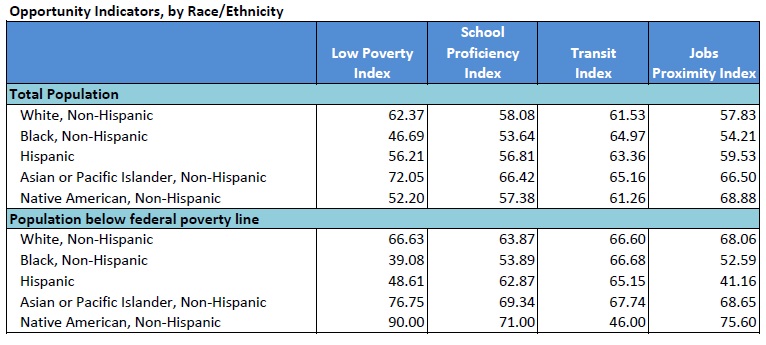
Source: Department of Housing and Urban Development, Affirmatively Further Fair Housing Data, June 2017.